
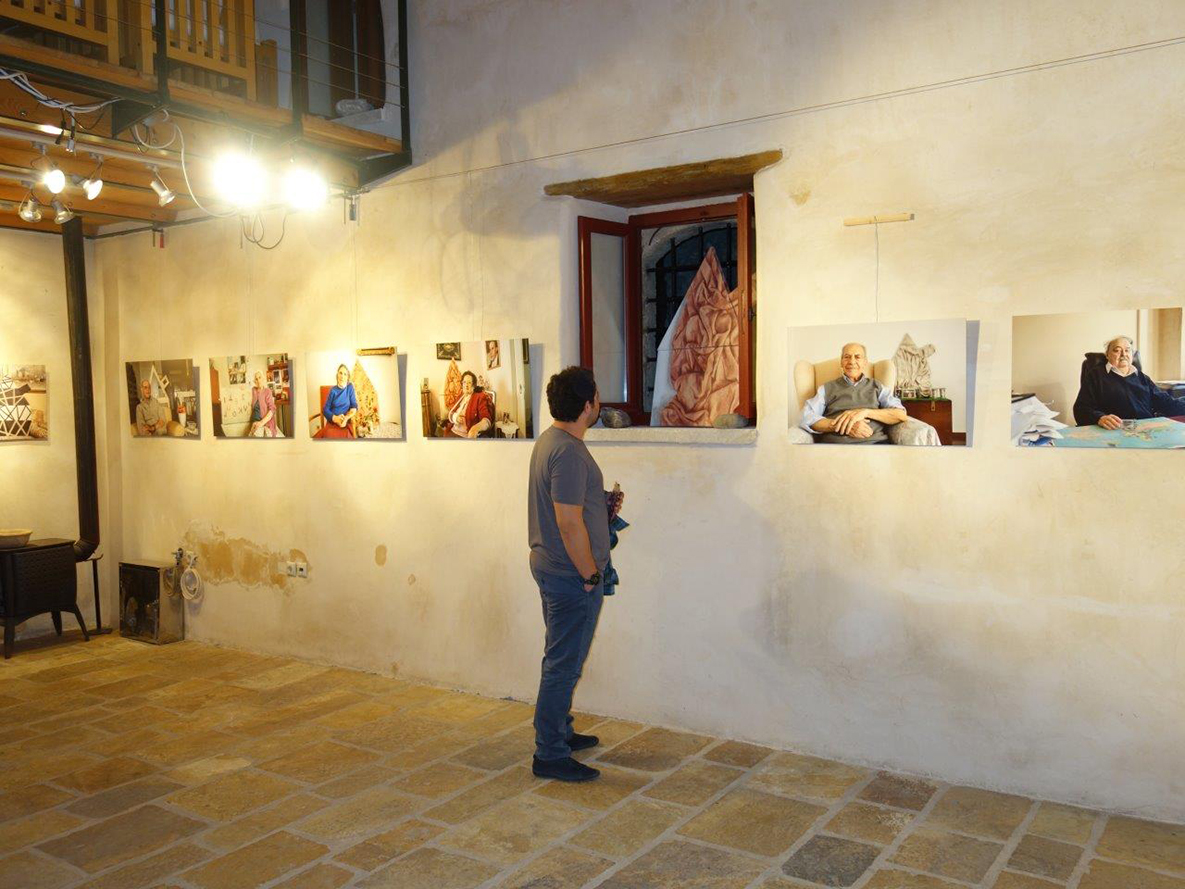
“Survivors: Greeks Who Survived the Shoah”, Kythera Photographic Encounters 2016, Zeidoros multi-purpose building, Kapsali, Kythera (curator: Penelope Petsini).


Postmemory and Trauma: Embodied Returns
And so they are ever returning to us, the dead.
W. G. Sebald, The Emigrants
In 1958, Henry Moore, chairman of the Competition for the International Monument to the
Victims of Fascism in Auschwitz-Birkenau, admitted how difficult it was for the plastic arts to cope with memory when he raised the following question: “Is it in fact possible to create a work of art that can express the emotions engendered by Auschwitz?” Almost a decade earlier, Adorno’s famous quote (“To write poetry after Auschwitz is barbaric”) put into words the material and moral difficulty involved in representing the Holocaust. In response, certain academics argued that only ‘literal’ representations could sufficiently address the memory of this, “the century’s most viciously literal event”. Adorno himself later partly retracted his statement: “Perennial suffering has as much right to expression as a tortured man has to scream; hence it may have been wrong to say that after Auschwitz you could no longer write poems” (trans. E. B. Ashton). He concluded that it is not just art that survives after Auschwitz, but also survivors themselves, marked by their survivor guilt. […]
Just as physical contact with the Nazi concentration camps triggers traces of connection and reconnection, activating memory and restoring its attitudes and effects, contact with the survivors themselves is linked with trauma and loss. In the ongoing project Greek Jews Holocaust Survivors, Artemis Alcalay has been seeking for years the now elderly Greek Jews who survived the Auschwitz and Bergen-Belsen camps. Placing this series of portraits in the context of her visual work Home: a wandering (2012), in each new visit to one of the survivors the artist brings along one of her “houses”, her own constructions alluding to the archetypal little house with the chimney, instantly recognizable across almost all cultures – constructions with which she wandered in the previous years in various parts of the country, well-known and obscure alike: memorials, cemeteries, synagogues, churches, house terraces. The house is a symbol, not just of the family they lost and their home that was also lost or trespassed, but also of the life they had to make from scratch after they came back from the camps. It serves as a “passport”, by means of which the doors and memories of these individuals are unlocked, as they consent to being photographed, revealing the marks of history that have been carved on them.
Some of them refuse being photographed, trying to keep the ghosts of the past at bay. Sometimes, it is their family that tries to protect them from reliving their trauma. Most of them though are posing, smiling, serious or awkward. They are waiting for the artist, dressed up, as polished as possible, often joined by their families, giving the impression of a ritualistic event unfolding in the photo session. The number of the camp visible on their arms, at time clear, at times faded or half-erased, almost always take centre stage, sharply juxtaposed to the soothing effect of the little house. “Their survival into old age is an inconceivable victory. The number of their arms is a constant reminder of that”, wrote historian Odette Varon-Vassard.
Exploring what Marianne Hirsch describes as postmemory, how the children of collective trauma survivors adopt and process personal experiences and memories, this series of portraits ultimately serves as an allegory about the meaning of the family home and the psychic “home”, safety and belonging, and the Jewish identity overall. At the same time, it is also a study on memory, trauma, and healing. And silence. Let us not forget, as Alcalay suggests, that in the first post-WWII decades, most survivors, faced with the bleak reality they had to handle, opted for silence.
Penelope Petsini
Panteion University